Rising damp.
Rising damp is water from the ground soaking up through a wall, the way a sponge draws up water. It only affects walls that touch the ground, usually stops within about a metre of the floor, and leaves a tide mark of salts. Most damp blamed on rising damp turns out to be a bridged damp-proof course, a leak or condensation.
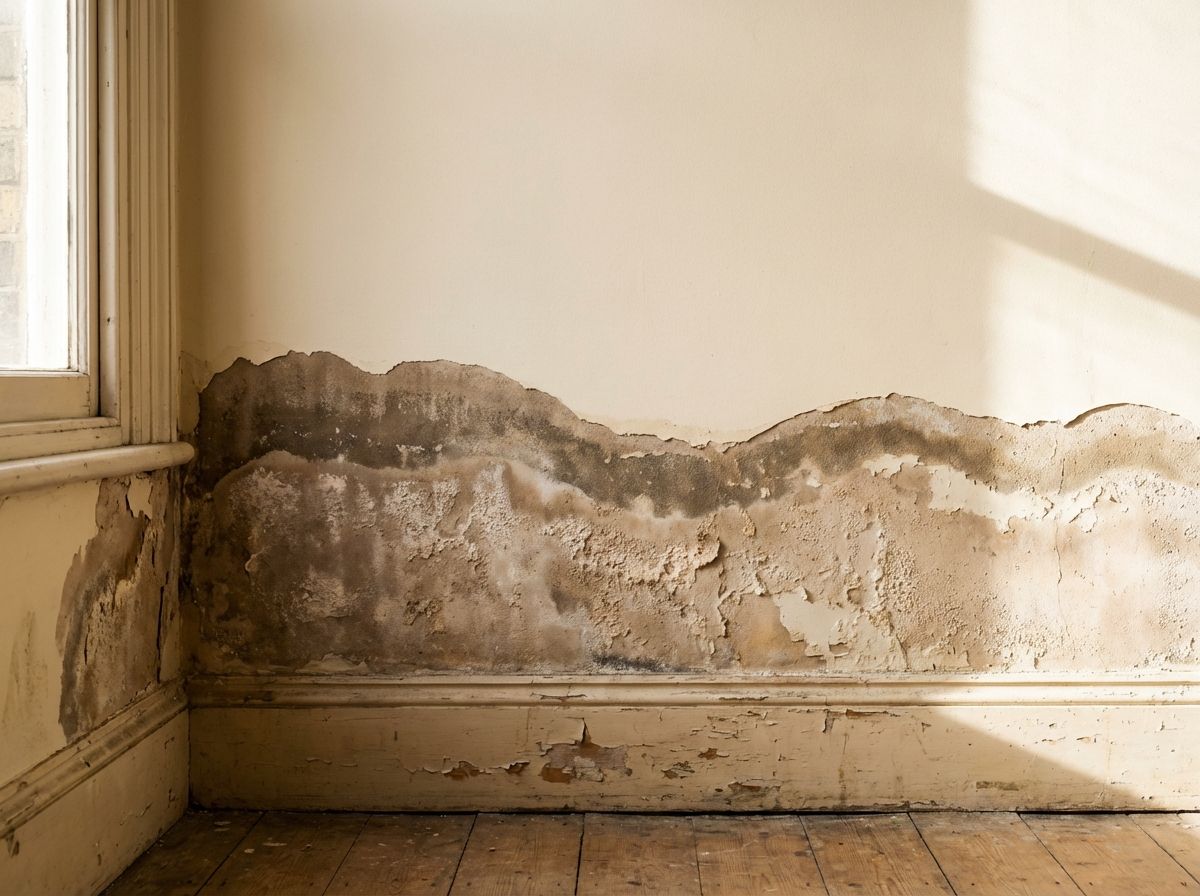
Signs to look for
- A tide mark about 0.5 to 1.2m up the wall, with a clear top edge
- White, fluffy salts on the plaster or brickwork
- Skirting boards that are soft, blistered or rotting at the bottom
- Wallpaper lifting from the bottom up
- Damp that is worse in winter but never fully dries out in summer
Why rising damp is over-diagnosed
Real rising damp is much rarer than the number of injection quotes suggests. The English Housing Survey puts it at about 1 in 100 homes. Part of the problem is the meter. The pronged meter most surveyors press against a wall measures how well the surface conducts electricity, not how much water is in it. Salts, foil-backed plasterboard and even some paints will push the needle into the red on a dry wall.
That matters because the treatment is a big job. Injecting a chemical damp-proof course means drilling into the mortar every 120mm, then hacking off the plaster to a metre high and replastering. If the real cause was a blocked drain or a raised patio, you've paid for major work and still have the damp.
So we test before we treat. Thermal imaging comes first, because damp areas show up colder than the wall around them. Where a reading needs confirming, the reliable test is a carbide meter on a drilled sample, which gives the actual moisture content rather than an electrical guess. Together they show whether water is coming up, coming in, or condensing on the surface.
What actually causes it
Many Sussex houses built before the late 1870s have no damp-proof course at all. One only became a requirement through the building byelaws that followed the Public Health Act 1875. Slate or bitumen damp-proof courses fitted after that can fail, but usually in one spot rather than along a whole wall.
Far more often the damp-proof course is fine and something is bridging it. Ground raised by a new driveway or decking, render carried down over the damp-proof course, rubble in a cavity, or a garden wall built against the house will all carry water past it. Fixing the bridge costs a fraction of injecting the wall.
How we treat it
Where rising damp is confirmed, we inject a damp-proofing cream into the mortar, which spreads and sets into a water-repellent barrier. Creams put far less liquid into the wall than the older pressure-injected fluids, and work more evenly in soft Victorian brick.
The replastering matters as much as the injection. Rising damp leaves salts in the plaster that keep drawing moisture out of the air, so if that plaster stays, the wall keeps reading damp long after the new damp-proof course is working. It needs replacing with a salt-resistant plaster, and the wall needs time to dry before you decorate.
Brick and stone dry at roughly 25mm a month, so a 225mm solid wall takes around nine months. Anyone promising a dry wall in a fortnight is talking about the plaster, not the wall.
Common questions
How do I know if it's really rising damp?
Check the height. Rising damp usually stops within about a metre of the floor. Damp that reaches the ceiling, comes and goes in patches, or appears upstairs is something else. The only reliable test on site is a carbide meter reading from a drilled sample.
Does a chemical damp-proof course come with a guarantee?
Yes. Our damp-proof courses come with a written guarantee, and the length is in your quote before you agree to anything. Whoever you use, ask whether the guarantee is insurance-backed. A company guarantee is only worth as much as the company.
Can I just paint over it?
No. Waterproof paints and coatings on the inside trap the water in the wall, and usually push the damp higher up or through to the other side. Deal with where the water is coming from first.